After 140 years, Coca-Cola has launched a new global visual identity system across 200+ markets. The brief, in the words of Global VP of Design Rapha Abreu: “one seamless visual identity, one recognisable brand experience to consumers.” The driver isn’t a brand in trouble; it’s a consistency problem at extraordinary scale, where 2.2 billion servings are consumed daily across 200+ countries, and the identity can drift.
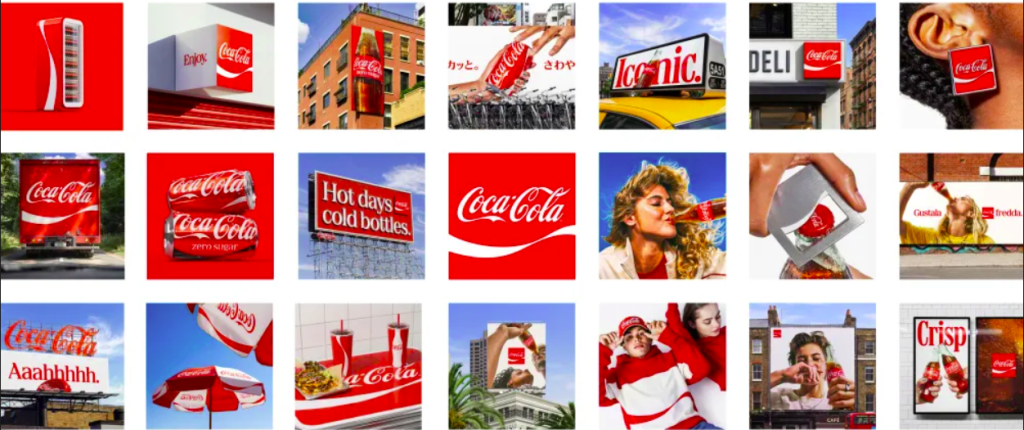
The refresh amplifies four core assets rather than introducing new ones: the bold red and white palette, the Dynamic Ribbon, the Arden Square, and the Spencerian script. The Dynamic Ribbon — first introduced in 1969 and originally derived from the contour of the iconic glass bottle — now plays a more dominant role across packaging, retail environments, equipment, and digital. Coca-Cola Zero Sugar gets its own distinct treatment within the same system: larger “Zero Sugar” text, a black Dynamic Ribbon on cans, and black bottle caps on PET packaging.
Alongside the visual work, Coca-Cola introduced a new Brand Center and Design Intelligence tool built for internal teams and agency partners – to govern how the identity is applied at global scale. The design work involved JKR (global brand identity), The SUPERULTRARARE (packaging system), and Brody Associates (proprietary typeface), with Adobe supporting the governance tools.
- The four amplified assets: Dynamic Ribbon, Arden Square, Spencerian script, red and white palette — none new, all made more prominent and consistently applied
- Rollout beginning across Latin America, Europe, Middle East, and Asia
- Zero Sugar evolution draws from Coca-Cola heritage while maintaining its own distinct visual cues within the unified system
- Photography standards developed with Guy Aroch, Anna Palma, and Martin Wonnacott — the system extends into creative direction, not just identity
For a brand at Coca-Cola’s scale, consistency is an infrastructure problem as much as a design one. The assets already existed. What this refresh adds is the governance layer, the Brand Center and Design Intelligence tools, that determines how those assets are used across hundreds of markets and agency partners simultaneously. The most important work here may never be seen by a consumer.