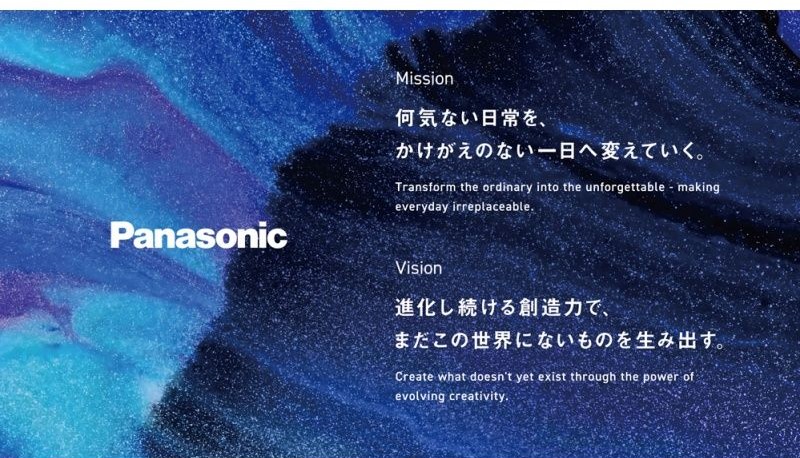
On April 1, 2026 , the first day of Japan’s new fiscal year, Panasonic formally completed one of the most significant corporate brand restructures in Japanese industrial history. What was once a single monolithic electronics company is now a group of distinct operating companies under Panasonic Holdings, each with its own identity, focus, and P&L. The entity that now carries the “Panasonic Corporation” name is no longer the old sprawling giant. It’s a newly defined company dedicated specifically to lifestyle solutions: consumer electronics, related devices, and business solutions — and it launched that new chapter with a new mission statement: “Transform the ordinary into the unforgettable — making everyday irreplaceable.”
The restructure had been building since 2022, when Panasonic converted to a holding company model. But April 2026 was the hard reset: the old Panasonic Corporation was effectively dissolved, its divisions spun into independent companies, and the Panasonic name handed to what had previously been called Panasonic Entertainment & Communication. Meanwhile, the automotive systems arm — one of the world’s largest suppliers to Toyota, Honda, and Tesla — announced it will rename itself Mobitera in April 2027, signalling its intent to operate as a fully independent brand. On the same day, Panasonic also handed US TV manufacturing to China’s Skyworth, mirroring Sony’s deal with TCL weeks earlier. Two of Japan’s most recognised TV brands exiting hardware production in the same month is not a coincidence but a signal.
- The split creates eight distinct operating companies including Panasonic Energy (EV batteries, supplying Tesla), Panasonic Connect (B2B supply chain and factory solutions via Blue Yonder), Panasonic HVAC & CC (heating, ventilation, cold chain), and Panasonic Electric Works (now transferring its power tools arm to Makita)
- Group CEO Yuki Kusumi chose the Japanese word Yomigaeru meaning “reborn” as the kanji to represent 2026, describing the year as the company’s “turnaround to the growth phase”
- The new Panasonic Corporation’s mission is a clear consumer and B2B lifestyle pivot away from hardware commodities, toward experiences and services built around the home and everyday life
- Panasonic Connect is already one of the most interesting B2B brand stories in Japan: a 100-year-old manufacturing brand repositioning itself as an enterprise software and supply chain intelligence company, competing with SAP and Oracle on factory floor solutions
- The Skyworth TV deal and the Mobitera automotive rename are both exercises in the same logic as Sony/TCL: the brand has more value than the manufacturing, so protect the brand and shed the cost base
Brand architecture is business strategy made visible. What Panasonic has done over four years isn’t cosmetic — it’s a complete answer to the question of what a 100-year-old Japanese industrial group is actually for in 2026. By separating energy, automotive, B2B software, and consumer lifestyle into distinct brands, each one can now credibly compete in its own category, rather than being diluted by association with the others. The risk of doing nothing — staying as one undifferentiated megabrand — was becoming invisible everywhere.